
So have you gotten the idea I like Old San Juan yet?
Well, it was finally time to leave this beautiful city, after all, we were over here for a certain engagement; ah yes, the house-sit. We had to get to Fajardo (pronounced Fa-har-doe), on the east side of the island to catch the ferry to Vieques. We had allowed ourselves a whole day to get there and had arranged to couchsurf overnight in Luquillo, a surf town near Fajardo, before catching the ferry the next morning. Once you leave the major cities, couchsurfers are few and far between in Puerto Rico. We were lucky to find someone nearby.
We could've spent a truckload of money and flew straight to Vieques but of course that was out of the question. Instead, there was a ferry that left from Fajardo for Vieques that cost only $2 one-way. But how to get there? Our options were taxi, car rental or public transport. Taxi or rental car were cheaper than a flight, but still more expensive than we wanted to pay. We decided to keep them as a back-up plan. There are no buses or trains in Puerto Rico outside the major cities, instead, to get around the island cheaply but slowly, we'd have to take the público - a shared taxi.
This was a new concept to me. I was confused about exactly what it was, let alone how much it cost and or if we'd have to take more than one. Information was fairly vague: "private vehicles that transport groups of people between city centres. It is possible, albeit difficult, to travel to many cities using publicos alone" said "Let's Go" Travel Guide. They also warned to be prepared to spend several hours waiting' publicos will only leave when there are enough passengers and will also stop to pick up passengers along a semi-flexible route. Prices ranged from $5 - $60 depending on which information you believed, but all sources agreed you must allow four hours - for a ![]() typically one hour drive. These formidable fragments of information were disconcerting; I had visions of Kathleen Turner on that ratty old bus in Romancing the Stone when she realises she's on the wrong bus. I was nervous, but I was willing.
typically one hour drive. These formidable fragments of information were disconcerting; I had visions of Kathleen Turner on that ratty old bus in Romancing the Stone when she realises she's on the wrong bus. I was nervous, but I was willing.
 typically one hour drive. These formidable fragments of information were disconcerting; I had visions of Kathleen Turner on that ratty old bus in Romancing the Stone when she realises she's on the wrong bus. I was nervous, but I was willing.
As luck would have it, our hero Ali came to the rescue and offered to drive us! He was adamant that we not take the público and to that I was truly thankful and very much relieved. He'd only just gotten his car back from the mechanic after months without it too. Even more generously, he was going to take us sightseeing along the way, and little did we know, we were in for a Puerto Rican Taste Extravaganza. Of course, his gorgeous little dog Ozi would also come along for the ride. So the four of us set out early in the morning on this last Saturday in April headed east.
Driving out of the city walls I was reminded again that the greater area of San Juan was nothing much to look at; a grittier version of a typical American city. Large billboards, flashy chain restaurants, and storefronts brandishing garish bars screamed at me from all directions. Bars on windows, doors, balconies - any opening, would be a common fixture from here on out. Litter would also be a huge concern.
Soon enough we left the modern world behind (but not the trash) and entered backwoods (or backjungle)-country along Road 187, which weaves along the coastline. As we followed the road we soon entered into a thick black haze. Though there was no need to be alarmed, it was smoke burning from outdoor grills.
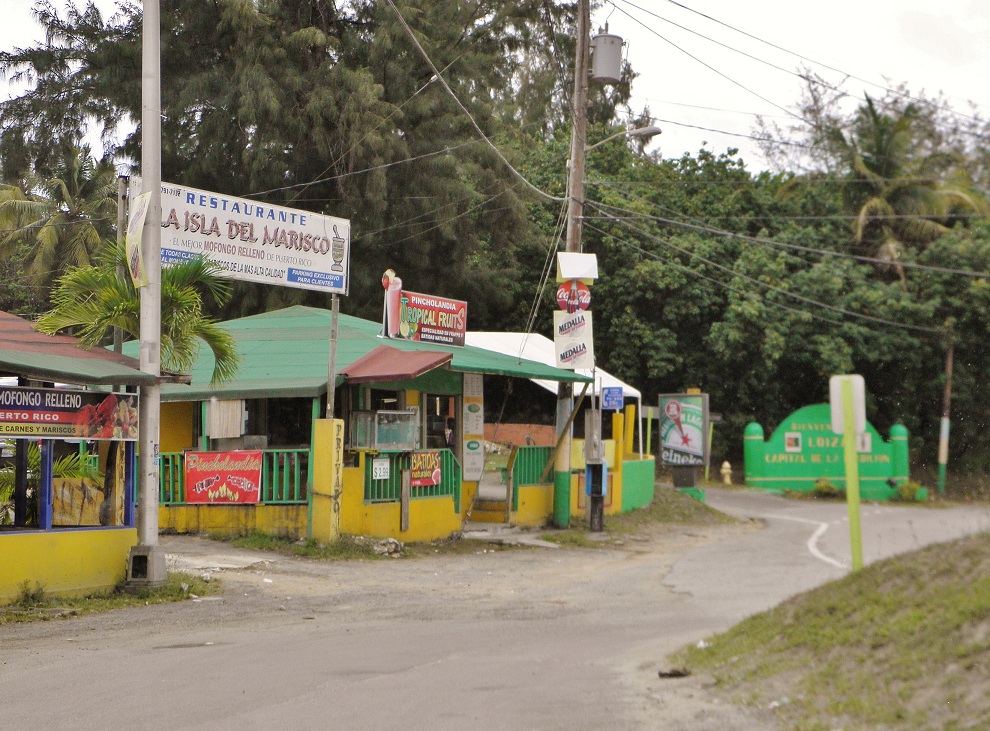
They lined the road in succession, their operators huddled under what could only be described as swelteringly hot marquees, churning out Pinchos (kebabs) on open flames. Further along, the same thing was happening but the haze was wafting out of open-air shacks on dusty streets; the insides charred permanently black. No fire laws here I guess. And you wouldn't want to be predisposed of a lung condition.
We were driving through the town of Loiza, the self-proclaimed Traditional Heart of Puerto Rico.
The place looked, I hate to say, terrible; like a war-zone. Apart from the soot, litter seemed to tumble out of the shop-fronts and could be seen strewn as far as the eye could see. Buildings were dilapidated; scorched. It was actually welcoming to see advertising banners, the only colour and zeal to liven up the place. It was sad really, because there was much potential to be had and it was definitely a cultural experience. Puerto Rican street food is a insitution unto itself, and the people have turned it into an enterprise, establishing carts, tents, shacks or anything on a road, path or beach accompanied by any kind of invention of a grill or deep-fryer. We'd soon find they are ubiquitous all over Puerto Rico, and cheap. But thankfully we didn't stop here; we'd stop somewhere a little less asthma-inducing.
(* See end of post for update)
(* See end of post for update)

Next we went off road, hitting the sand dunes; well, sand roads really. Bumping along faster than I was comfortable with over sandy tracks carved through palm and seagrape trees. Ozi was going nuts wanting to get out and run around; he was actually crying, it was pitiful! So we stopped at one of these secluded beaches and Ali and Ozi went for a run. The beach would've been really nice had trash not been customarily sprinkled about. You wonder what one thinks when they do this to their own piece of paradise. While Ali gave a bit of an explanation when he said that there was a large problem with stray dogs and that they tear people's garbage apart, sitting on the beach, observing beer cans and the like clustered about, I couldn't help but think it was mostly a human problem.


There are plenty of blind turn-offs on this stretch of road to pull into the sand dunes and take a swim. Just don't pull in too far and get stuck like some people we saw on the way out! Back on the sealed road we were about to turn inland when Ali started getting thirsty; he was craving Mavi. We looked at him perplexed. And his explanation left us no more satisfied. The roadside shop we stopped at was part fruit and veg shop, part deli, general store and seafood market (live blue-swimmer crabs were on display in a cage out front) all in one. Amongst that they also sold fresh puerto rican juices. Mavi (Mauby in other parts of the Caribbean) is the juice extracted from the bark of the Mavi or Colubrina tree mixed with sugar and spices. Doesn't sound so great, does it? Chase and I sampled Ali's before deciding to reject it completely. It was kind of interesting, a little like root beer (originally from the root of the sassafras tree, a common carbonated drink in the States), but it was a bit strong and funky for our liking. Chase got a fresh coconut water instead - straight from the coconut itself; all they do is pop the top off, jab in a straw and away you go, coconut and all. It's called Coco Frio, the water from a cold, green coconut. He liked it, but I thought it a bit weak. It was definitely just like water with only a hint of coconut. Though while drinking it he remarked that he couldn't tell how much was left because the coconut itself was so heavy.

 Chase with his Coco Frio and Ali with his Mavi juice
Just before we stopped in the tourist mecca of Luquillo we stopped in the Luquillo for Puerto Ricans. A long row of restaurants and takeway shacks, known as The Kiosks, line a street just off of Route 3 and sit just back from the beach. As soon as we pulled in I could tell it was very much a locals place, a place where I probably wouldn't have stopped on our own, but travelling with Ali I wasn't worried at all. We started off at the east end and a endless row of back-to-back shops unfurled before us. Of course, they didn't have the best curb appeal but they looked nicer than anything else we'd seen so far this day, much nicer. It was a feast for the senses and the palate. We refrained from stuffing our stomachs and our arteries, mostly we just admired all kinds of fried food and traditional Puerto Rican stews and rices behind glass windows - like perusing a living museum of Puerto Rican culture.

Walking along a rainbow of coloured buildings it seemed the further along we went down the line the nicer and more elaborate they got; starting with nothing more than a takeaway counter and culminating in a full blown restuarant. Most were something in-between and most of them sold the exact same thing. It had a really casual, beachy vibe about it, some even had stools up at window counters for customers. Most shops had openings on either side, from the road/car park side through to the beach side, usually with patio seating on the latter.
Puerto Rican fried food is a variant on many Caribbean and Spanish concoctions and it is a fried cuisine completely unlike anything I've seen. Called Frituras, they have long things, round things, cone things, pancake things...the list goes on. I'll give you a quick run-down of these and some other Cocina Criolla, traditional PR foods, we discovered during our tour.


Bacalaitos or Bacalao: are the large flat round things which look like potato scallops. They are a deep-fried mixture of shredded salt-cod fish and batter.
Relleno de papa: is a deep fried ball of mashed potato with a ground meat filling.
Taquitos: these are tortillas rolled tightly and deep fried till they are crisp, usually with some kind of filling.
Pastelillos/Pastellos: Somewhat like an empanada or pasty, but with a more thin and flaky dough. They contain all kinds of fillings; ground beef, pork, chicken, seafood etc.
Pastelillos/Pastellos: Somewhat like an empanada or pasty, but with a more thin and flaky dough. They contain all kinds of fillings; ground beef, pork, chicken, seafood etc.
 Alcapurrias: made from a doughy mixture of mashed up tropical tubers and root vegetables, usually yautía (like a taro) but can contain ground squash, plantains and green banana. It is filled with ground meat or seafood and deep fried in oil (photo right).
 Surullitos: are the golden fried finger-shaped things. They are made from cornmeal, almost like a corndog without the sausage.
 Canoas de Platanos - sweet plantain "canoes" stuffed with ground meat and covered with melted cheese. These looked delicious and creative - the things they do with a plantain around here! (Picture right).
 Tostones: These are those flattened and fried green plantains, usually served as a side, that I was telling you about in an earlier post.

Arroz con habichuelas: rice and red beans - the Puerto Rican staple. It is simmered with ham hock and Puerto Rican spices. Traditionally stewed with vegetables for a hearty meal.
Piononos: two sweet plantains sandwiched around a savory filling, usually a ground meat mixture called picadillo. The whole sandwich is then deep-fried in batter. Whoa! We had to try this one, it sounded and looked so good! (Pic right).
Carne Guisada - Puerto Rican beef stew
Chase getting into his pionono, (top), and below, more dishes including sliced green bananas with onion!


Out on the beach groups of Puerto Rican families were gathered enjoying each others company and their surroundings. One group even had a boom-box hanging from a tree - ingenious. However, the weather was starting to turn. The clouds were rolling in dark and sinister-looking, turning the sea a dull blue fringed with frothy foam when it broke. Then small spats of rain began to drop. Gently at first, then suddenly it became a torrent. We were quite far from the car, having walked the length of the kiosks and then cross to the beach. We took shelter under the nearest tree but that was pointless. We made a mad dash to an abandoned patio of one of the kiosks. We were drenched head to toe. I rung out my dress. We waited. The rain didn't dissipate, if anything, it got harder.

Then we saw the saddest thing. A little black dog, maybe two years old, shivering forlornly in the corner. Shrunken and manged. I've never, in my life, seen a dog's expression look so sad. I couldn't look. There was nothing I could do, so I couldn't look. But I'll never forget the look in his eyes.
Finally, Ali took one for the team and ran back to get the car. We drove the last small stretch to our destination, passing the entrance to El Yunque National Forest, which has the only toprical rainforest in the US national rainforest system and is supposed to have a magnificent waterfall to swim at. It's a green wonderland with an expanse of feathered emerald flowing and ebbing over trees, bushes and jagged misty peaks. It's a place we'll definitely have to visit during our stay.
Luquillo lies on the north east coast of the mainland of Puerto Rico and is pronounced Lu-KEE-yo. We didn't know anything other than that it was close to Fajardo when we set out. Turns out, it's a a bit of a resort area with a number of lovely beaches, including one of the finest in the territory, and has been labelled the Puerto Rican Riviera. And to Chase's delight, it was also a surfing hot spot. But we didn't have any time to spend sightseeing or lapping up the sand and surf, it was strictly an overnighter; we had to be on the ferry the next day to meet Eric, the home-owner of our hous-sit.
Luquillo lies on the north east coast of the mainland of Puerto Rico and is pronounced Lu-KEE-yo. We didn't know anything other than that it was close to Fajardo when we set out. Turns out, it's a a bit of a resort area with a number of lovely beaches, including one of the finest in the territory, and has been labelled the Puerto Rican Riviera. And to Chase's delight, it was also a surfing hot spot. But we didn't have any time to spend sightseeing or lapping up the sand and surf, it was strictly an overnighter; we had to be on the ferry the next day to meet Eric, the home-owner of our hous-sit.
We were too early to meet Coden, our couchsurfing host, so we decided to find a cafe or bar to hang out in and wait. We actually found a great place called Boardrider's Rum Shack Bar and Grill. It's across the road from Playa La Pared, the surf beach. Surfing might not be the best here but it exists and apparently it's consistent. We met the owner, Juan, a young surfer dude who walked around the restaurant bare-foot and shirtless - what a life! We asked him how long he'd been here, he said "all my life". This space we were sitting in used to be his garage that he turned into a bar! The house is upstairs, he inherited from his parents.
 |
| Boardrider's Rum Shack Bar and Grill |
 And I guess, where there's surf, there's an Aussie, which didn't really excite us. Of course he was half drunk and boasting about his gig working on a yacht docked at fajardo and how he was best mates with Juan and the other local surfers. But the locals were all very friendly and it was a really cosy, relaxed place, definitely the best spot to kill an hour or so. There was a small patio area out front with a few tables and a pull-up window-bar seating. I had a quesadilla and Chase had his favourite - wings. It wasn't that agreat but it didn't matter. We even came back here for dinner with Coden because the place he wanted to go - some fantastic pasta place - was closed.
Speaking of Coden, he had a great apartment overlooking the ocean with a big hammock stretching the length of his balcony. He even ordered us a taxi for the morning's ride to Fajardo!
---------------------------
*There are actually some more tourist-friendly kiosks around Loiza at a place called Piñones by the beach. Pictures show cute little beach huts in a landscaped setting with more civilised cooking techniques. They've turned this into a great little area which re-instates my faith in the rejuvination of Puerto Rico. There's a wonderful boardwalk that runs along the coast conducive to cycling and across the street the Pinones State Forest reserve has some awesome trails. I haven't been there yet, but by the pictures it looks comparative to coastal trails I've been on in New Zealand (here's hoping so!). To take a tour click here.


